Guide · Efficiency, margin and productivity
The 7 wastes live in the office too.
A 6-step method to find in the office the same wastes Toyota hunted on the factory floor, starting with what costs nothing to stop doing.
Every waste on the assembly line has a match at someone's desk.
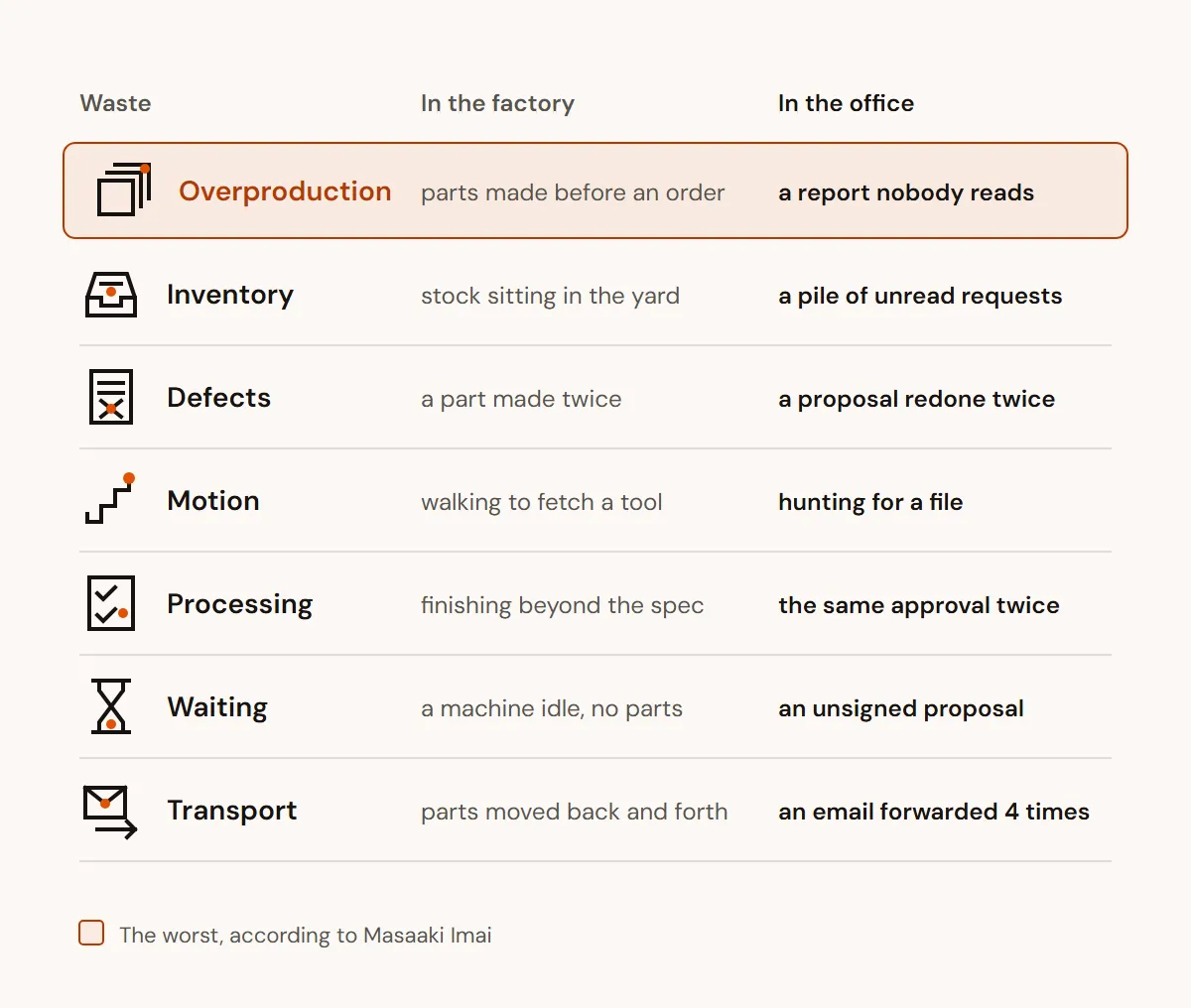
The 7 wastes of the Toyota system, in the factory and in the office
The question
Taiichi Ohno, the engineer who built Toyota’s production system, spent a day watching workers and then asked them to do at least one hour of work a day. The workers took offense, because they were busy their entire shift. Ohno meant one hour of work that adds value. The rest of the day went into walking, searching, waiting and redoing.
In an office, the question is the same, and the answer tends to be alarming.
Up to a third of the office week goes into work that adds no value.
Share of the week office workers identified as adding no value, in %
Masaaki Imai, who popularized kaizen in the West, reports these studies in his book on improvement at the workplace. In a 40-hour week, that range comes to somewhere between 10 and 15 hours per person.
When to use it
When the team is always busy and the customer still waits. When margins shrink while sales hold steady, and part of the cost may sit in the hours the team spends on work that adds no value. When the proposed fix for delays is hiring more people or buying a system. And before you automate a process, because automation only makes the waste move faster.
The 7 wastes outside the factory
Ohno sorted waste into seven types. They were born on the assembly line, but they show up in any work that passes from one person to another, whether it’s a part, a document or a piece of information. The table at the top of this guide gives one example from each side.
Of the seven, overproduction is the worst, according to Imai. It gives a false sense of security and hides the other problems. In the office, it’s the weekly report nobody opens and the polished proposal for someone who didn’t ask for one.
Imai adds an eighth, time. It’s the document sitting on a desk or in a system waiting for a decision or a signature. In his view, the other seven all end up as lost time.
Step by step
- Pick a flow the customer feels. A quote, an order, a hire or an invoice. Start with just one, ideally the one that draws the most complaints.
- Follow one real case from start to finish. Rebuild its path: who received it, who touched it, who approved it and when it went out. The kaizen rule is to go where the work happens. In the office, that means opening the inbox, the system and the WhatsApp of the people doing the work, instead of asking in a meeting.
- Separate what adds value from what doesn’t. There’s only one question: would the customer pay for this step? Checking again, forwarding, waiting and redoing rarely pass the test.
The quote spends more than 40 hours waiting and just over 2 being worked on.
Hours of work and of waiting at each step of a quote, at an example distributor
Intake
0.2 hours work, 4 hours waiting: 4.2 hours
Technical check
0.5 hours work, 18 hours waiting: 18.5 hours
Discount approval
0.1 hours work, 16 hours waiting: 16.1 hours
Building the proposal
1.2 hours work, 3 hours waiting: 4.2 hours
Sending to the customer
0.1 hours work, 1 hours waiting: 1.1 hours
- Name each waste. Use the seven types as a checklist. Naming it helps you discuss the problem without blaming anyone: the problem is the wait for approval, and the manager who approves is just where it shows up.
- Start with what’s free to stop doing. Removing waste almost always means no longer doing something, which is why it costs little. The report nobody reads can go next week. The second approval can become a discount limit by tier.
- Standardize the new way and measure again. Write down how the flow now works, agree on it with the team and repeat the measurement a month later. To measure, use the method for measuring how long an order sits idle.
An illustrative example
Picture a distributor that takes almost a full working week to answer a quote. Adding up the steps, the quote gets just over 2 hours of work and sits idle for 42. The technical check and the discount approval account for almost all of the waiting.
In this example, the fix needs neither a new hire nor a new system. A discount table by tier takes approval out of most orders. The technical check now applies only to orders outside the standard. Both changes are waste the company stops producing.
Beyond the seven: variation and overburden
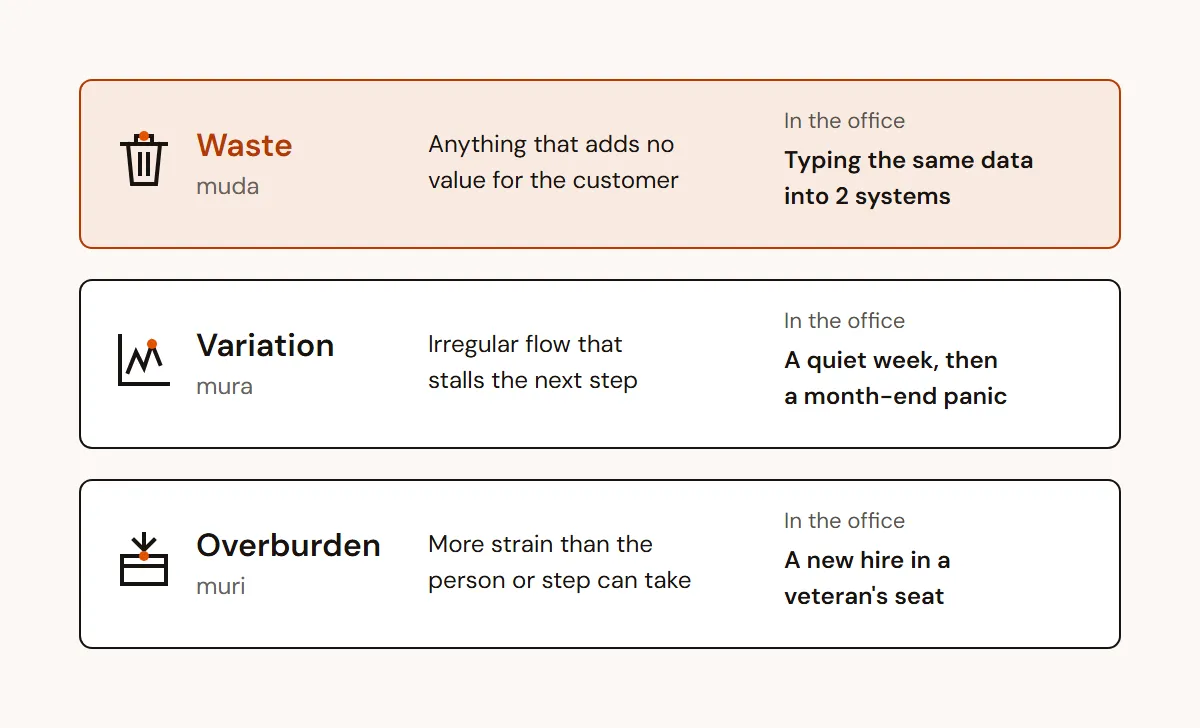
Kaizen pairs waste with two more Japanese words. Mura is variation, the irregular flow that stalls the next step. Muri is overburden, more strain than the person or the step can take. Both end up creating waste, and both are easy to spot once someone looks.
Waste, variation and overburden travel together.
The three signals kaizen uses to find the problem, with an office example
The most common mistake
Mistaking busy for productive. Imai tells the story of a foreman at a German carmaker who was satisfied as long as he saw his team working hard. In one week, consultants cut the tool changeover time on a press from 10 to 5.5 hours, changing only the way the work was done. The foreman admitted he had never looked closely at what his team was doing, only at whether they were busy.
In the office, a full calendar and an overflowing inbox give the same impression. The useful question is what the team is busy with.
Do this tomorrow
Take the last quote your company sent and rebuild its path. Write down who received it, who checked it, who approved it and how long it sat between one person and the next. At each step, mark whether the customer would pay for it.