Guide · Technology, automation and AI
Before you automate, run the process by hand.
A 7-step test to find out whether a process can handle automation, before you pay for a platform, an AI agent or an integrator.
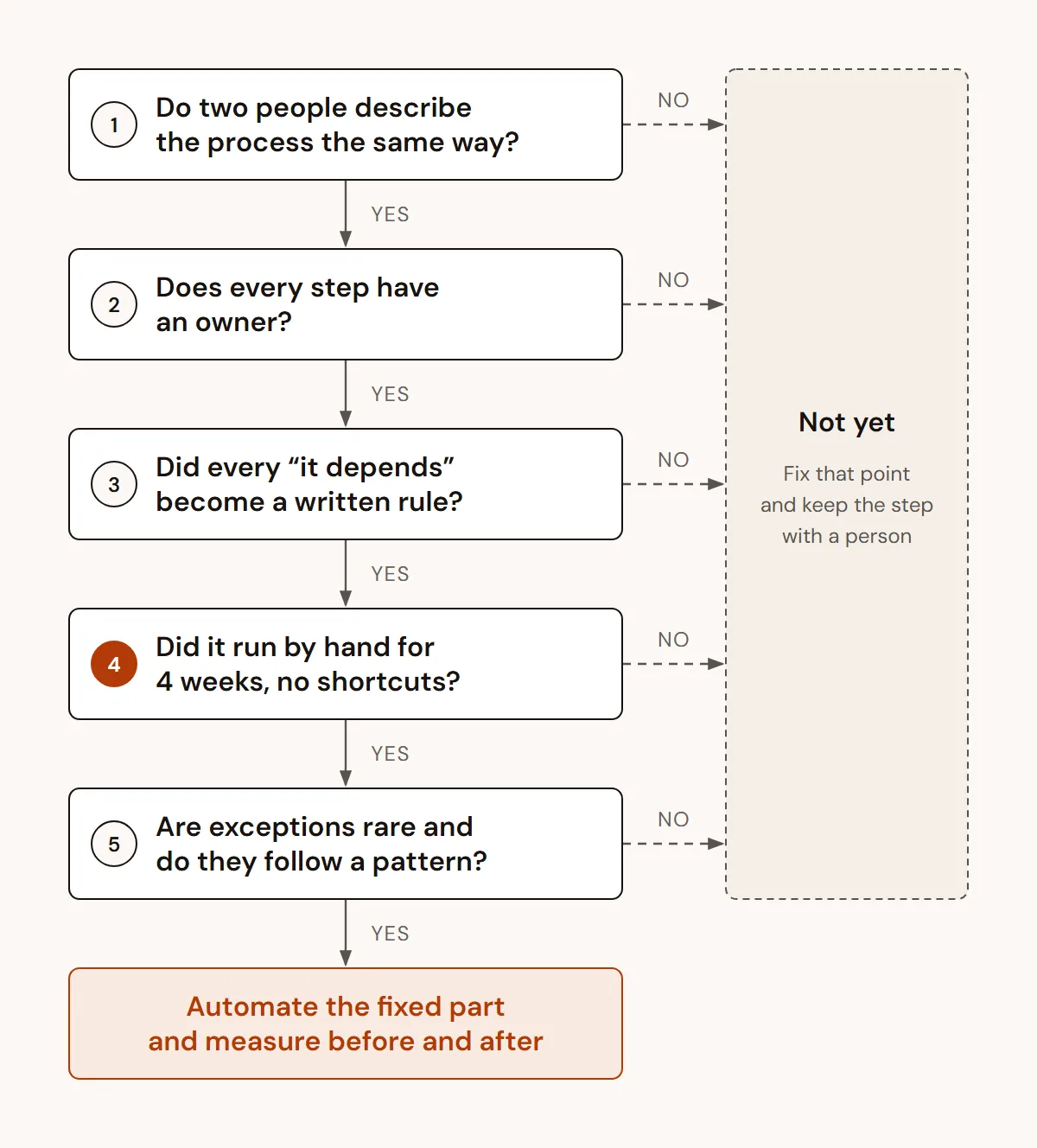
The test has five questions, and every no sends the step back to a person.
The questions to ask before you automate, in order
The question
Does the process you want to automate work today, by hand, without anyone having to improvise? If the answer is “more or less,” automation will repeat the “more or less,” only faster and at higher volume.
The reason is mechanical. Automation executes rules. Where there’s no rule, it either stalls or follows a path someone picked during setup without realizing it was a decision. A person working by hand notices the odd order and stops to ask. Automation doesn’t stop. The error that used to happen once a week, and that someone quietly fixed, now happens on every order of that kind.
By hand, the error shows up once. Automated, it shows up on every order of that kind.
Errors per week in an example process, with 12 orders of a kind the rule doesn't cover
When to use it
Before you hire an automation platform, an AI agent or an integrator. When a vendor offers a bot that “takes care of customer service.” And when an automation you already have keeps breaking, and someone on the team spends the end of the day fixing by hand what it did.
Step by step
- Write down the process the way it runs today. From the request that triggers it to the result, step by step, with the name of whoever does each one. What counts is what the team actually does, not what’s in the manual. If two people describe the same process in different ways, you’ve found the first problem.
- Give every step an owner. Each step needs one person who answers for it when it goes wrong. A step without an owner is where automation will fail without anyone noticing, because nobody is watching. If the answer to “who handles this?” is “the team” or “whoever is free,” the step has no owner.
- Turn every decision into a written rule. Wherever someone says “it depends,” write down what it depends on: discounts up to how much, which deadline in which case, where each type of order goes. Whatever lives only in one person’s head can’t be automated.
- Run the process by hand for 4 weeks with the new rule. Follow the written rule, no shortcuts, and log every time someone had to step outside it. A simple spreadsheet does the job, with the date, the step, what happened and who fixed it. Four weeks cover a month-end close, which is when exceptions tend to show up.
- Count the exceptions. Add up how many times the rule fell short and note the reason for each one. If an exception is rare and follows a pattern, it becomes a new rule. If it’s frequent and every case is different, that step isn’t ready yet and stays with a person.
- Automate the part that doesn’t change first. Start with the stretch that has a fixed rule and high volume: copying data from one system to another, alerting the owner, generating the standard document. The step that makes decisions stays with a person until the rule proves it can hold up.
- Measure the starting point so you know if automation helped. Before you switch anything on, record two numbers from the 4 weeks by hand: how long the process takes end to end and how many times it went wrong. Measure again a month after automating. Without a baseline, automation looks like it worked because it’s new, and nobody can prove otherwise.
An example
A company that sells to other businesses asked Novamedia, the company I founded and have run since 2021, for an automated WhatsApp service. A first contact waited a few hours for a reply, and a bot looked like the answer. Before talking about tools, I read the WhatsApp conversations, asked each person on the team which contacts they answered and counted the ones left without a reply. Something else came up: nobody knew who answered what, every contact landed in the same place, and some of them got lost. The problem was the lack of an owner. A bot in that process would have replied fast and then handed the contact to no one.
The bot wouldn't have fixed the missing owner. The criterion and the owners did.
The path of a WhatsApp contact, before and after
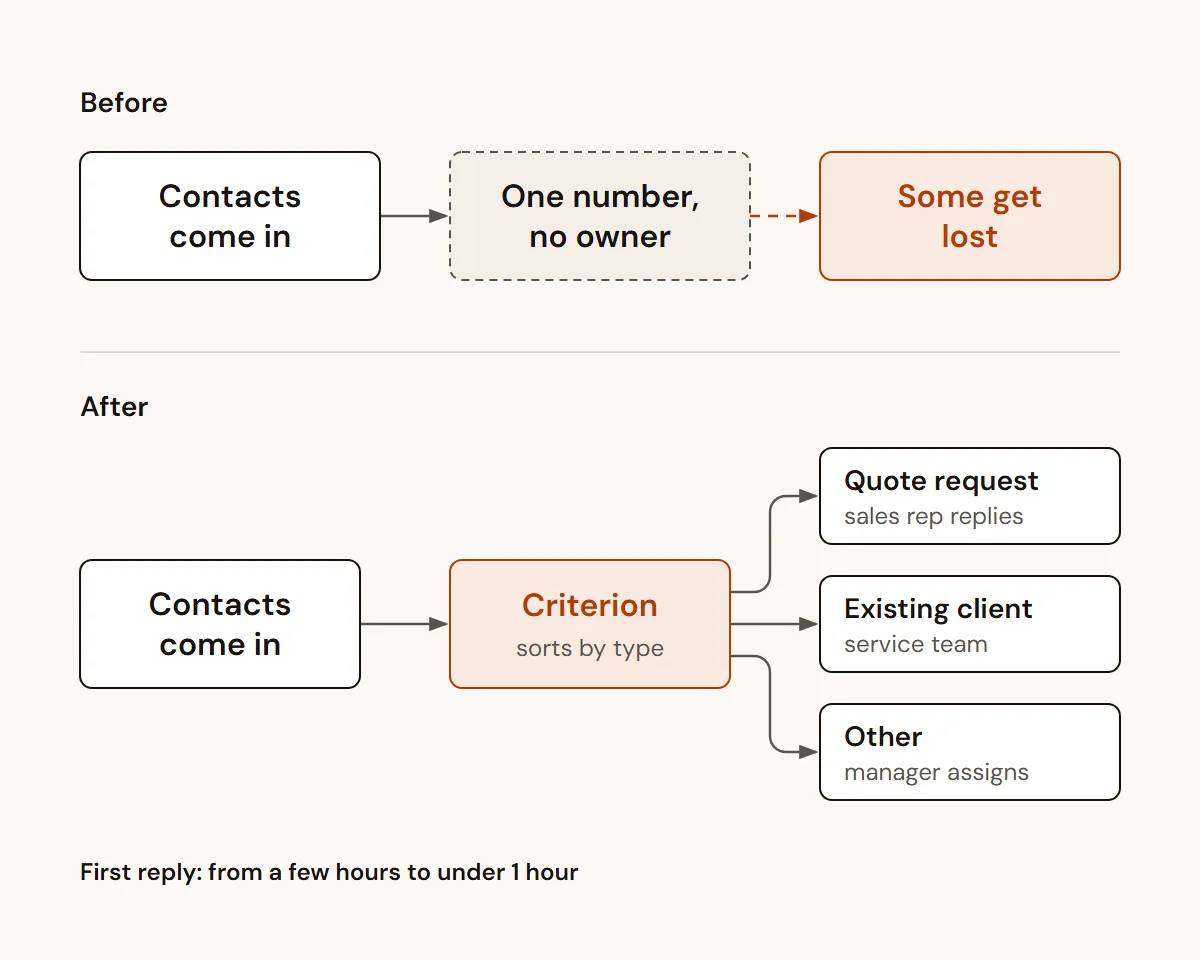
The process came first: one owner for each type of contact, a criterion to qualify whoever comes in and a deadline for the first reply. Only then did automation come in. The first reply went from a few hours to under 1 hour. The full case is in Problem reading 08.
The most common mistake
Choosing the tool before writing the rule. The vendor’s demo tends to work well because it runs a clean process, which isn’t yours.
I’ve been automating workflows since my days in IT at DuPont, in the 2000s, and the slow part was never the tool. It was uncovering the rule each person applied without ever writing it down. With AI, the stakes go up. A language model gives an answer even when it has nothing to base it on, so the step that makes decisions needs a person checking it until the rule is proven. Whoever answers to the customer is still someone on your team.
Do this tomorrow
Pick the process you most want to automate and ask two people on your team to describe it in writing, each one alone, in 5 lines. Compare the two versions and mark where they don't match.