Guide · Revenue and commercial operations
Your value proposition has to beat doing nothing.
A 6-step test to write your value proposition from the customer's real alternatives, including the option of leaving everything as it is.
The most common competitor isn't on your list of competitors.
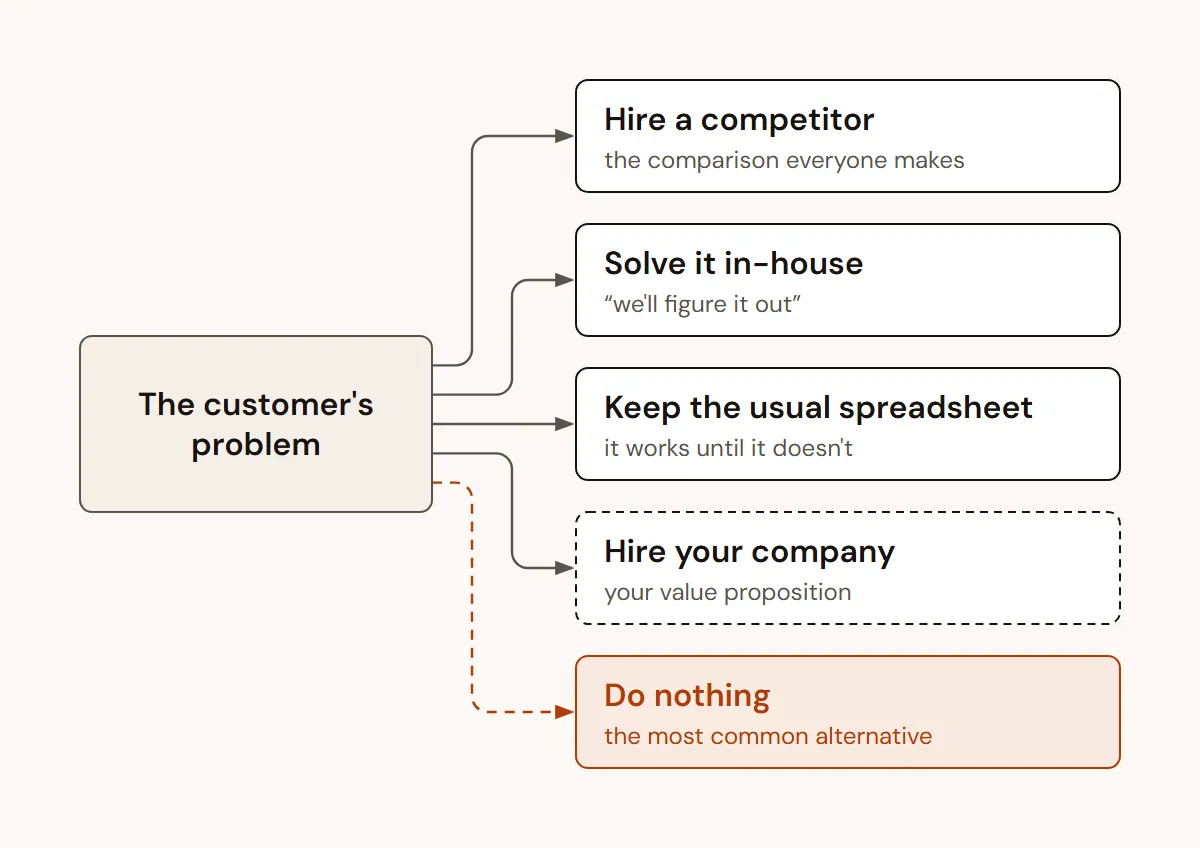
What a customer can do with the same problem
The question
What would your customer do if your company didn’t exist? The answer is rarely the competitor you track. Most of the time, they’d keep muddling through, or put it off.
Matt Dixon and Ted McKenna analyzed more than 2.5 million recorded sales conversations and published the results in Harvard Business Review in June 2022. Between 40% and 60% of lost deals ended with no decision: the customer said they wanted to buy and didn’t.
When customers don't decide, fear of getting it wrong outweighs habit.
Why deals were lost to no decision, in %
A value proposition that only compares itself with competitors misses the target. It has to show why acting now costs less than waiting, and why choosing you is safe.
When to use it
When your company’s pitch would fit any competitor: quality, speed, service. When the customer loves the meeting and then goes quiet. When sales loses more deals to “let’s revisit this next year” than to another company.
Step by step
- List the customer’s real alternatives. April Dunford, who works on positioning for technology products, suggests starting with what the customer would do if you didn’t exist. That includes the competitor, the in-house team, the spreadsheet, the usual supplier and, almost always, doing nothing. An offer’s value only shows up when the customer compares it with those options. Ask the question of the last customers who signed and of those who walked away. The answers from the ones who walked away tend to show which alternative beat yours.
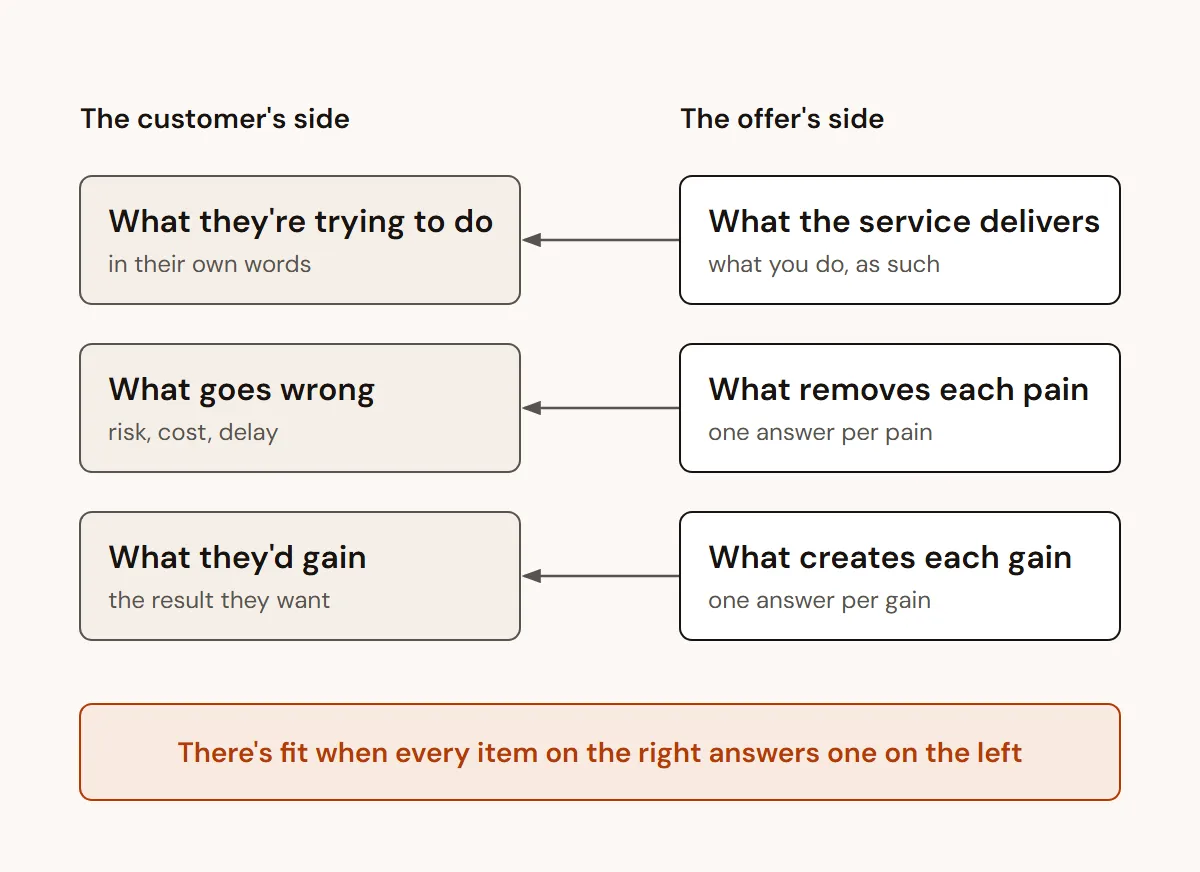
- Write the problem in the customer’s words. What they’re trying to do, what goes wrong along the way and what they’d gain if it worked. On the other side, for each pain and each gain, write what your offer does. There’s fit when every item on one side answers one on the other.
A value proposition starts on the customer's side and only then reaches the offer.
The two sides of a value proposition
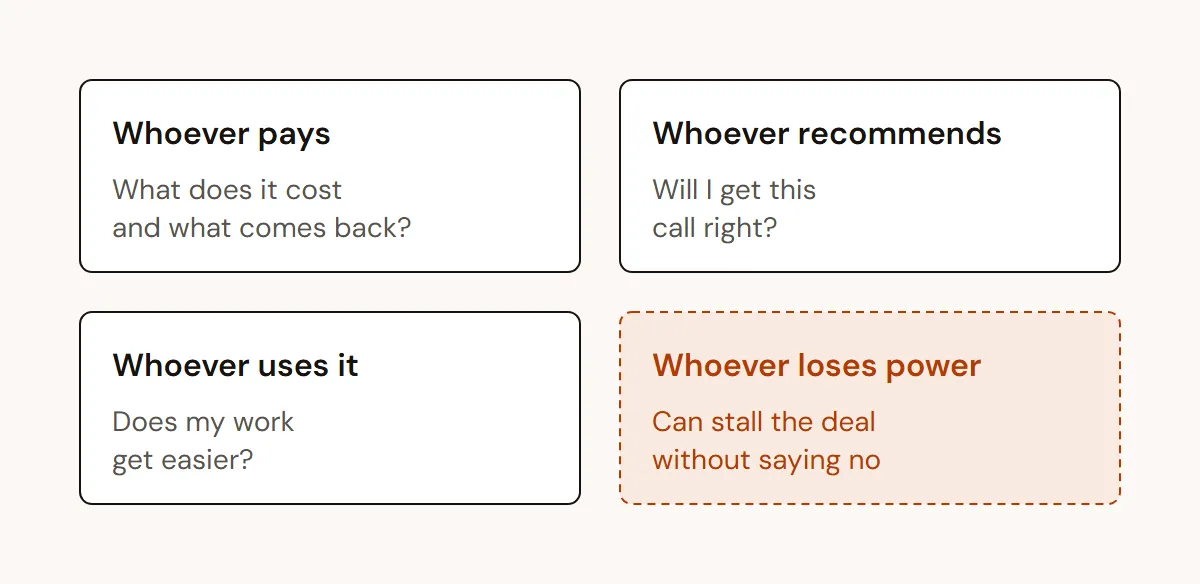
- Write a version for each person in the decision. In a business purchase, whoever pays, whoever recommends and whoever uses it have different concerns. There’s also whoever loses power from the change and can stall the deal without ever saying no. One sentence won’t convince all four.
Each person in the decision asks a different question.
The roles in a business purchase and what each one wants to know
- Translate the value into numbers, time or money. Value you can measure opens the door: fewer days, lower cost, more sales. What you can’t measure, such as safety or clarity, has to become something concrete, like hours of a stopped line, rework or decisions put off. And there’s the opportunity cost, which is what the customer can’t do while the problem persists.
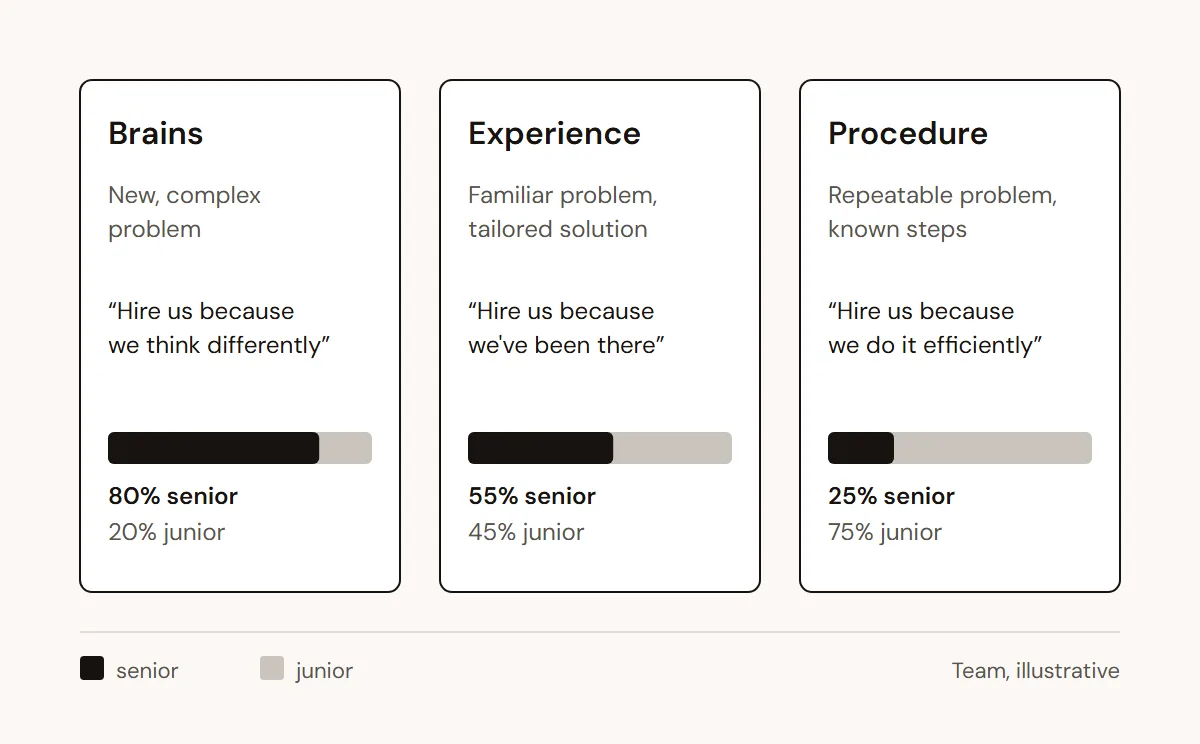
- Say what kind of service you sell. David Maister, who studied professional service firms, separates three kinds. One sells brains for new problems. Another sells experience with familiar problems. The third sells efficiency on a repeatable procedure. Each calls for a different proposition and a different team. Promising brains and delivering procedure is a fast way to lose trust.
The kind of service sets what you promise and who does the work.
Three kinds of professional service and the team each one tends to need
- Test with 4 or 5 conversations per type of customer. Show two or three versions of the proposition and ask the customer to rank them from most to least useful. Ask why for each choice. The version you like best won’t necessarily come first.
An illustrative example
Picture a company that maintains equipment for manufacturing plants. Its pitch talked about certified technicians, fast service and original parts. Three competitors said almost the same thing.
When the company asked customers what they’d do without it, the most common answer was “call someone when it breaks.” The real alternative was waiting. Each person in the decision wanted something different. The maintenance manager wanted fewer line stoppages. The CFO wanted a cost that didn’t change every month. The owner wanted to stop missing deliveries to the big customer.
The new sentence speaks to the problem, the alternative and whoever pays.
A maintenance company's value proposition, before and after
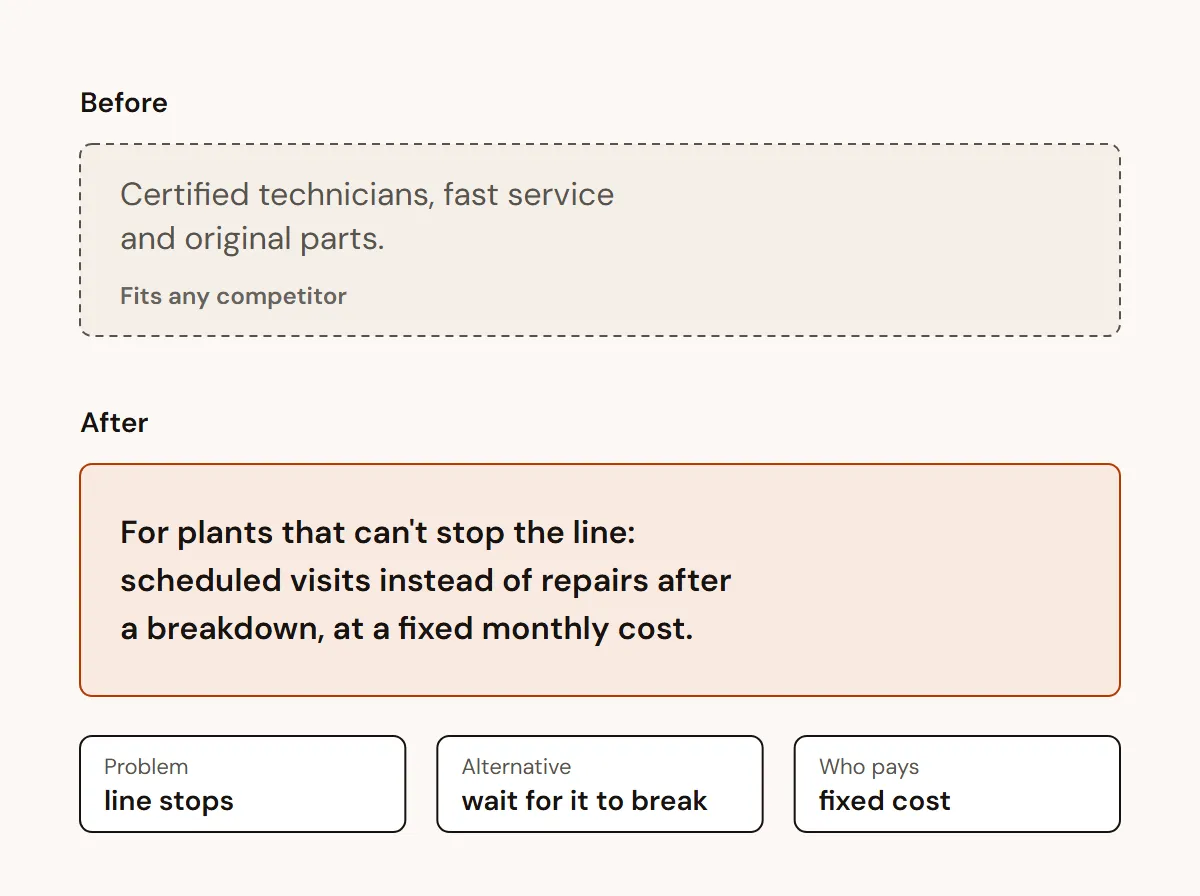
The new sentence doesn’t mention technicians or parts. It talks about the stopped line, compares itself with repair after a breakdown, which was the real alternative, and gives finance the fixed cost it wanted.
A caveat
Byron Sharp, a marketing researcher, disagrees with putting differentiation at the center of everything. In his view, brands grow more by being easy to recognize and remember than by being different. For a service bought rarely and with a lot of money at stake, I’d still start with the value proposition. His point holds anyway: say the same thing, the same way, for a long time. A proposition that changes with every presentation doesn’t stick with anyone.
The most common mistake
Describing what the company does instead of what the customer stops losing. “We’re experts in X, with Y years in the market” answers a question the customer didn’t ask. Their question is different: what happens if I do nothing?
Do this tomorrow
Call 3 customers and ask what they would have done if your company didn't exist. Write the answers down in their own words and count how many times some form of leaving things as they were comes up.