Guide · Efficiency, margin and productivity
Your next failure already has a cost, and it needs to be in your price.
A 6-step method to measure how often what you sell comes back with a problem, what each return costs and how to build that cost into your price.
In 2025, warranty cost US manufacturers more than US$30 billion.
Warranty claims paid in 2025 by sector, in US$ billions
The question
How often does what you sell come back with a problem? And what does each return cost? Few companies can answer both. Industry has a name for the first one: MTBF, mean time between failures.
In 2025, US-listed manufacturers paid more than US$30 billion in warranty claims, according to the Warranty Week annual report from April 2026. On average, warranty claims ate up 1.30% of everything they sold. That sounds small until the math reaches profit.
On a 5% margin, average warranty cost takes more than a quarter of profit.
As % of revenue, at an example company with warranty at the 2025 US average
What MTBF is
MTBF is operating time divided by the number of failures. A machine that ran for 500 hours and failed 5 times has an MTBF of 100 hours. It comes paired with MTTR, the mean time to resolve each failure. Together they give you availability, which is MTBF divided by the sum of MTBF and MTTR, as Atlassian’s metrics guide lays out. The higher the MTBF and the lower the MTTR, the longer the customer has what they bought actually working.
How GE built MTBF into the price
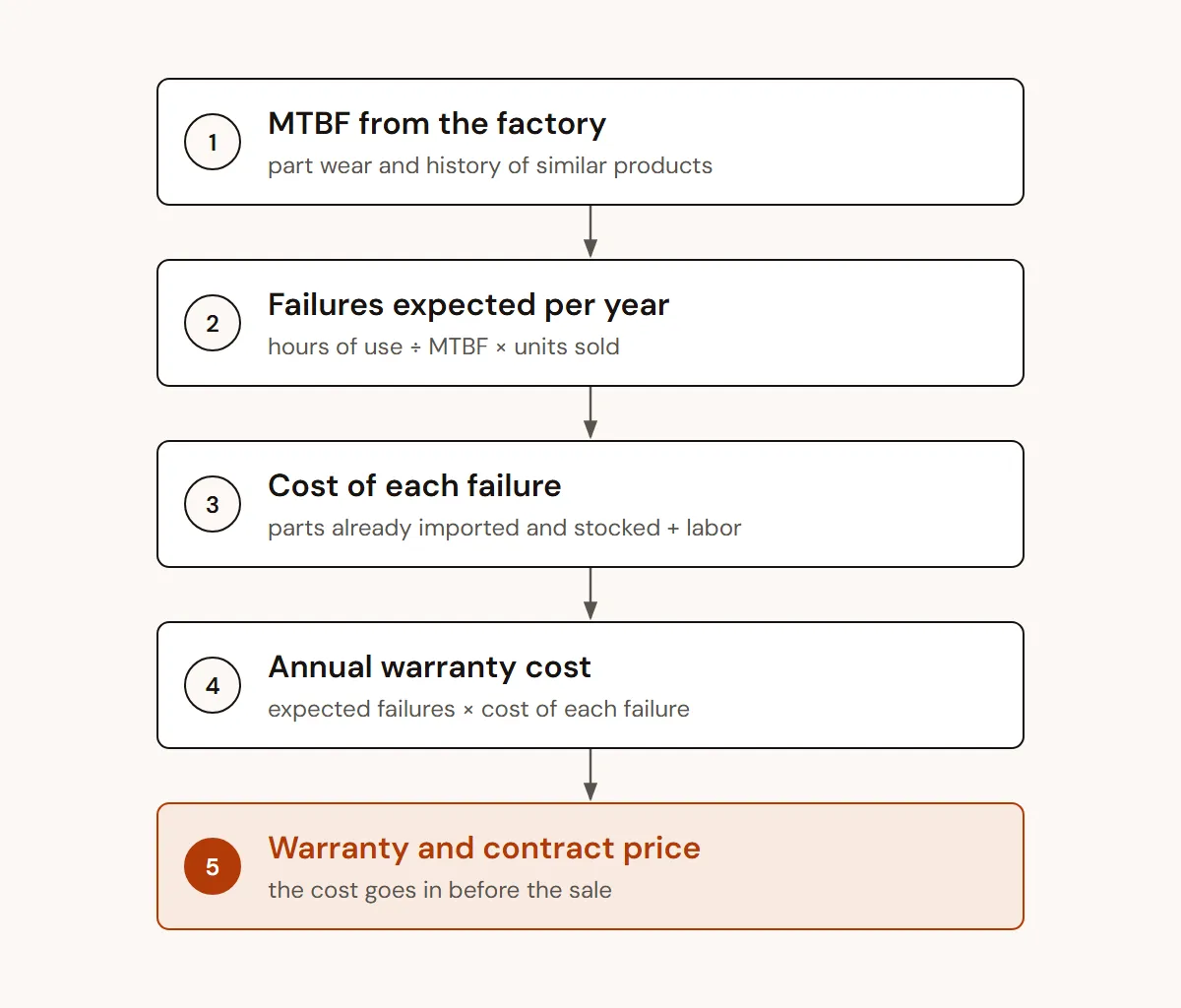
At GE, when I worked on medical equipment launches in Latin America, I was responsible for building the warranties and service contracts. The calculation started with the MTBF from the factory, based on the expected wear of parts and components and on the history of similar products. From it, we estimated how many failures the units sold that year would have.
Then came the local cost of each part, already imported and stocked, and the labor hours each failure would take. The annual warranty cost came out of that multiplication and went into the price before the sale.
The cost of failure goes into the price before the sale.
How MTBF became the price of the warranty and the service contract
The logic isn’t limited to medical equipment. It applies to any company whose customers can complain, ask for their money back or take more work than agreed.
When to use it
When a contract’s margin disappears after the sale. When support is always putting out fires and nobody knows how many people it needs. And whenever the company sets a warranty, a contract term or a return policy.
The MTBF of a service
In a service, a failure is rework, a ticket, a complaint or a refund. Operating time can be counted in days, in hours or in number of deliveries.
For a service, the MTBF math is the same.
120 days of deliveries for an example service, with three failures along the way
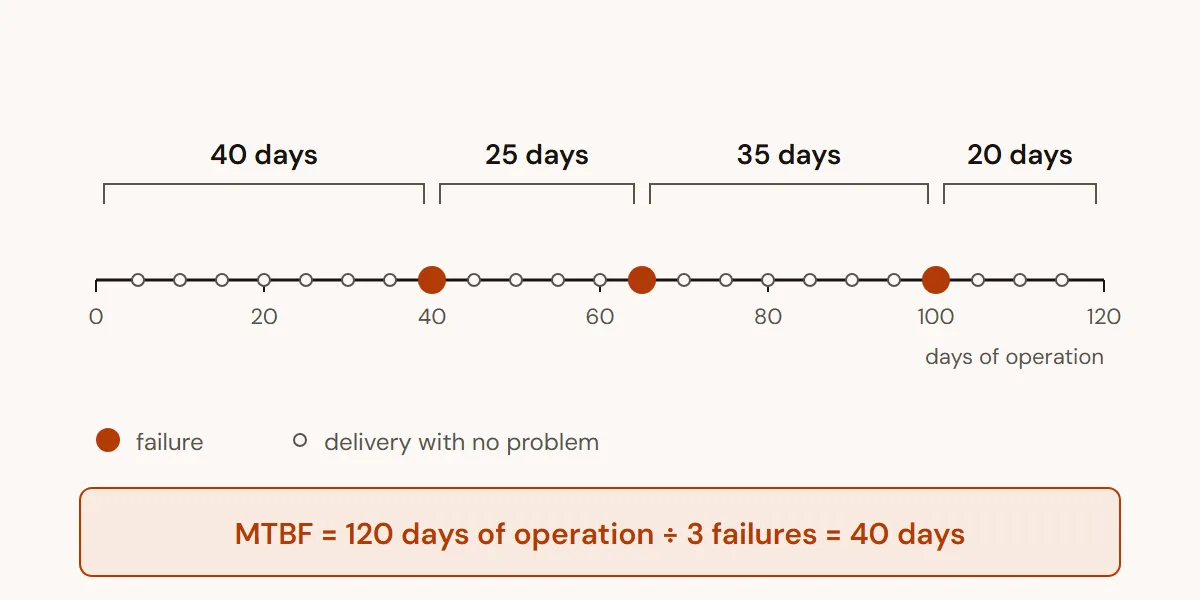
The gaps between failures vary, and that’s normal. MTBF looks at the whole period: add up the operating time and divide by the number of failures. In the example, 120 days with 3 failures give an MTBF of 40 days.
Step by step
- Define what counts as a failure. Use the customer’s point of view: a return, a ticket, a redo, a refund, a late delivery. Write the list down and don’t change the definition midway through.
- Measure operating time and count the failures. Pick a closed period, from 3 to 12 months, and a unit, such as days, hours of use, orders or contracts. MTBF is time divided by failures.
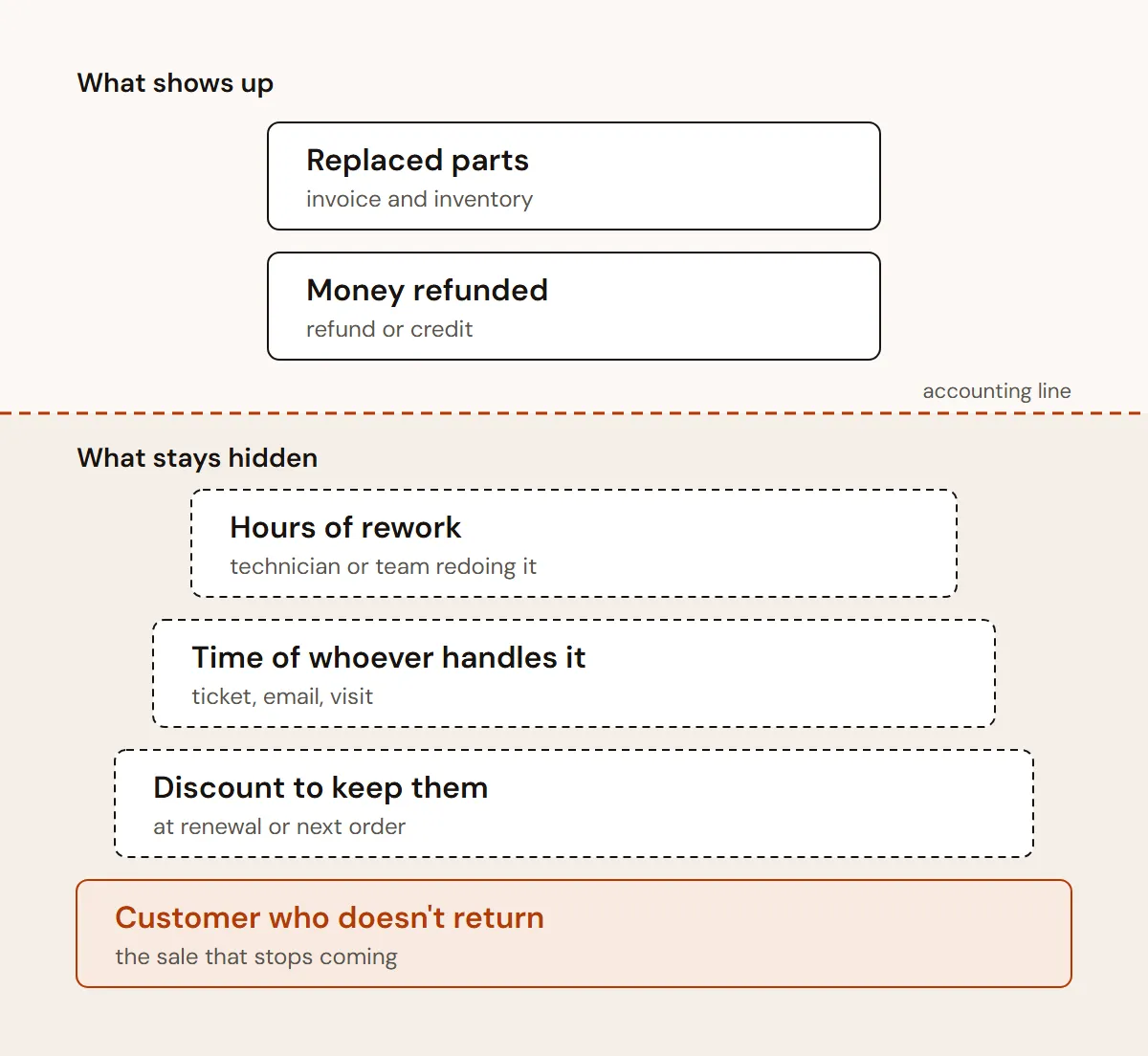
- Work out what each failure costs. Add up what shows up in the books and what stays hidden. Thomas Pyzdek and Paul Keller, in a quality management handbook, point out that the cost of failures that reach the customer rarely shows up separately in the accounts, and that it’s the most expensive kind, because the customer’s trust goes out the door along with the repair.
Most of the cost of a failure sits below the accounting line.
What shows up and what stays hidden when something comes back from a customer
- Multiply by the year’s volume. The total hours of use of what you sold, divided by MTBF, gives you the expected failures. Multiplied by the cost of each failure, they give you the annual cost. Compare that number with your margin.
- Build the cost into price and plan. The warranty, the service contract, the return policy, the size of the support team and the parts inventory all come from that number. Without it, the customer who takes more work pays the same as everyone else.
- Go after the costliest failures and track them monthly. Rank the causes by cost, start with the biggest and measure MTBF again the following month. A rising MTBF is margin coming back.
A worked example at a repair shop
Picture an auto body and repair shop that delivers 160 cars a month. Of those, 8 come back because the job has to be redone: the paint streaked, the noise didn’t go away, a part went in wrong.
The math uses four formulas:
- MTBF = jobs delivered ÷ comebacks
- Cost of each comeback = hours redone × hourly cost + parts + courtesy
- Loss per month = comebacks × cost of each comeback
- Loss per year = loss per month × 12
At the example shop, 1 car in every 20 costs US$24,480 a year.
MTBF and the cost of comebacks at an auto body and repair shop
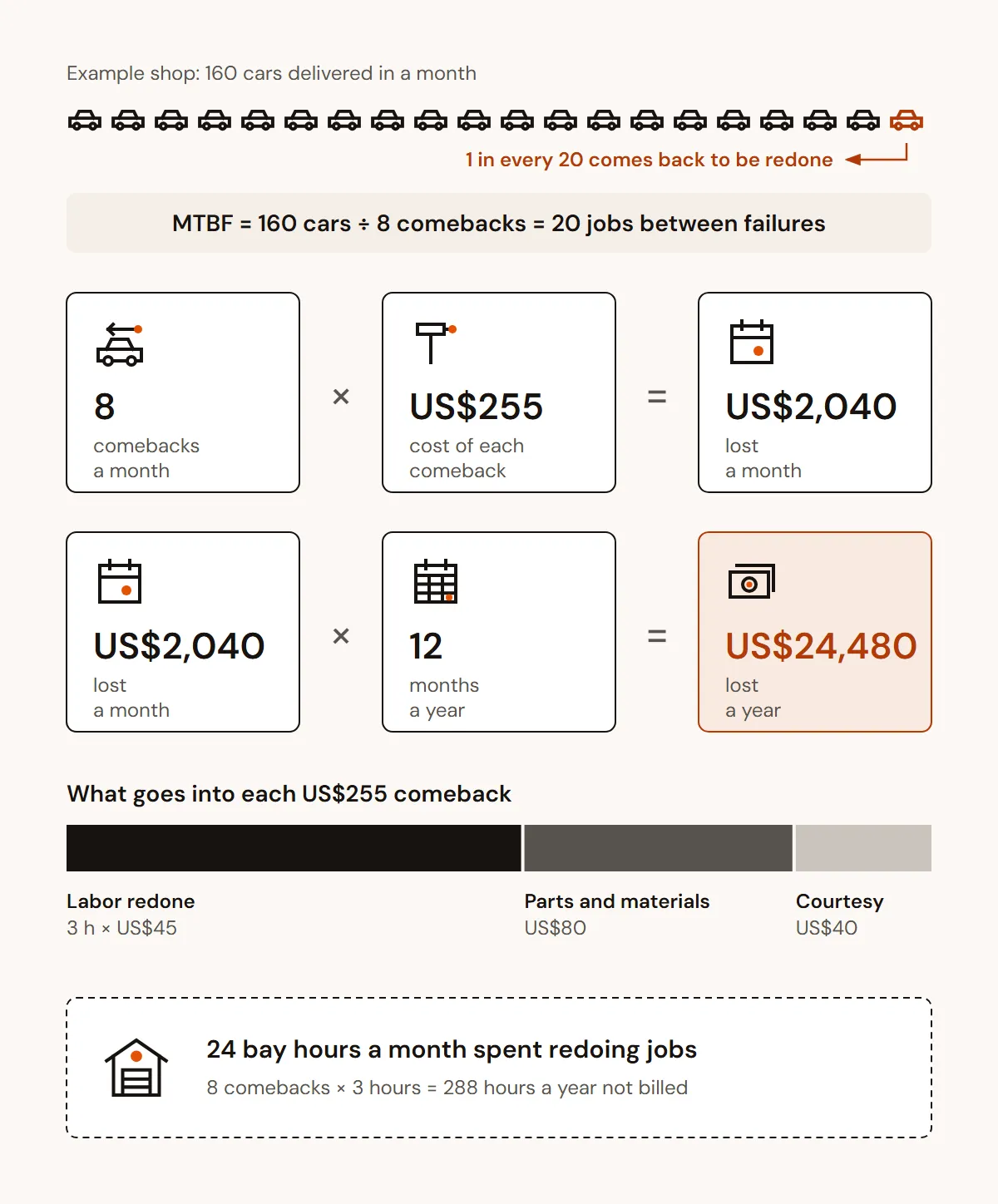
By this math, the shop loses US$2,040 a month and US$24,480 a year on comebacks alone. If it bills US$72,000 a month, with an average ticket of US$450, that’s about 2.8% of revenue. And the math leaves something out: the 24 bay hours spent redoing jobs could have been sold. At US$90 an hour, that’s another US$2,160 a month.
Cutting comebacks in half puts US$12,240 a year back into margin.
Direct loss from comebacks at the example shop, in thousands of US$ a year
With 4 comebacks a month instead of 8, MTBF doubles to 40 jobs, the direct loss drops to US$12,240 a year and 144 bay hours go back on the schedule. Not a single extra car has to be sold to get there.
Fewer breakdowns, twice the capacity
Masaaki Imai tells the story of Unga, a milling company in Kenya, in his book on kaizen. The machines were old and broke down often, and everyone said the only way out was to buy new equipment. Operators took over basic maintenance of their own machines, with cleaning, contamination control and a lubrication checklist, following Toyota’s maintenance model. Downtime fell, and one of the plants roughly doubled its capacity without buying a single machine.
The most common mistake
Treating failure as bad luck. A failure that comes back every month has a frequency and a cost, and both can be measured. As long as they stay out of the math, the company gives the warranty away for free and sizes support in a panic.
Do this tomorrow
Pull the complaints, returns and rework from the last 6 months. Divide the period by the number of incidents and you have your first MTBF. Then estimate what the most recent one cost, including the hours of whoever fixed it.